
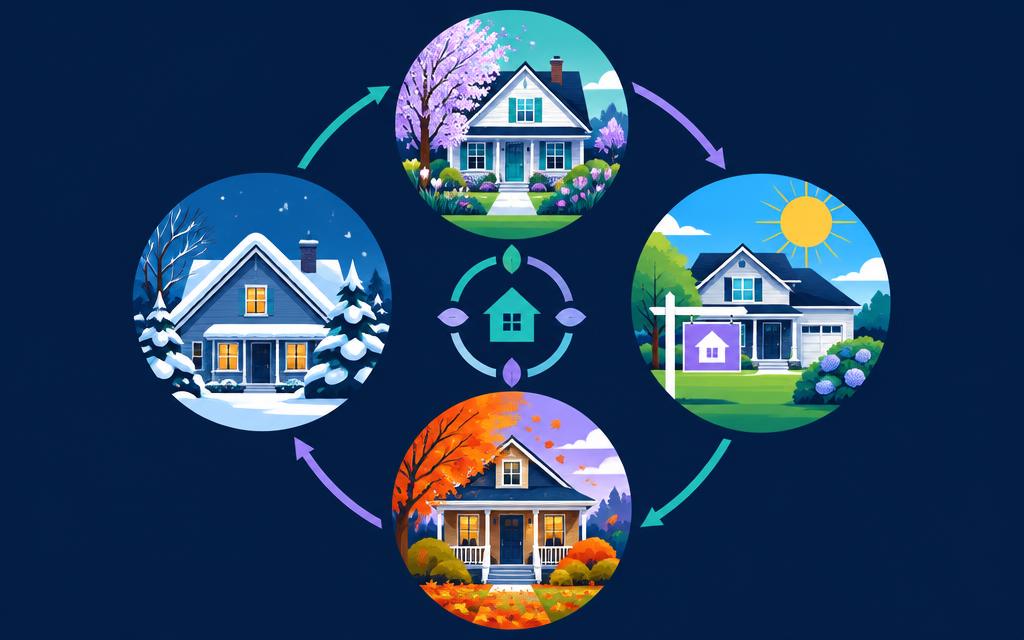
Most people think there’s one “buying season.” But purchases and refinances don’t move on the same clock.
- Purchases tend to follow a more calendar-driven rhythm (families, school schedules, moving logistics).
- Refinances tend to be more rate/condition-driven (borrowers act when the math + timing works and they can complete the process).
In this post, I’ll break it down by season—and most importantly—what to do with it as a Loan Officer, Realtor, or homebuyer.
Quick anchor: what purchase volume looks like
Based on the U.S. Existing Home Sales Volume (Seasonally Adjusted Annual Rate) data you provided:
- The highest month in your dataset is December 2025 (4,270,000 units).
- Volume stays relatively strong for a large portion of the year, and you can see variation month-to-month (for example, September is 3,990,000 for 2026 and 4,080,000 for 2025 in your dataset).
Takeaway: even when it feels unpredictable, purchase activity has a season pattern—and it’s useful for planning.
The 4-season cycle (simple version)
Spring Peak (March–June) — “Purchase Super-Season”
What tends to happen
- Purchases often climb because timing lines up for families and summer plans.
- Refi activity can be steadier, but it usually depends more on whether borrowers have a “window” to act.
What to do
- LOs: Get documentation flow and borrower readiness tightened early so your pipeline doesn’t get stuck when contract volume increases.
- Realtors: Set expectations that buying momentum tends to pick up in spring, and planning matters.
- Buyers: If you want in, get your paperwork and decisions ready sooner—not later.
Summer Plateau (July–August) — “Closing Peak”
What tends to happen
- Purchases can remain moderate to high.
- Closings and operational timelines can feel busiest.
What to do
- LOs: This is where good workflow matters. When processing is smooth, you look calm even when volume is high.
- Realtors: Be ready for tighter timelines and keep communication smooth.
- Buyers: Respond quickly with what’s needed—speed matters more than ever.
Fall Fade (September–October) — “Cool Down… unless rates create a window”
What tends to happen
- Purchase activity may cool as routines start back up.
- Refi activity can be more volatile—some borrowers move when conditions feel favorable.
What to do
- LOs: Treat refi like “opportunity windows,” not a guaranteed seasonal surge.
- Realtors: Use quieter periods to build trust and refine relationships.
- Buyers: If you’re thinking refinance, don’t wait for “the season.” Watch your personal timing and your numbers.
Winter Hibernation (November–February) — “Lower contract energy”
What tends to happen
- Purchase activity is typically slower (holidays + fewer moves).
- Refi can also be slower, unless conditions create a reason to act.
What to do
- LOs: Use this time to systematize, review conversions, and improve readiness for the next cycle.
- Realtors: Plan and prepare for the spring rush.
- Buyers: This can be a great time for planning—just less likely for immediate “rush” decisions.
The simplest difference to remember
- ✅ Purchases = calendar behavior
- ✅ Refinances = condition behavior
That’s why you can’t run your pipeline the same way all year—you need a system that adapts.
Bottom line
Seasonality isn’t about predicting every move perfectly. It’s about planning your workflow and managing expectations so you stay effective all year.
If you’re a Loan Officer, Realtor, or homebuyer and you want clarity on how this affects your next step, I can help.
Quick note
I’m Kim Rosnik, known as The Backwards Hat Advisor—because I focus on fixing the process and reducing the chaos, so you can spend more time on the work that actually grows your business.
Book time with Kim and see how I can be in service to you.
Book time with Kim 📅